When an FPGA project is almost finished – but still needs expert intervention
Brightelligence provides FPGA rescue services for projects that are close to completion but require expert intervention to become operational, stable, and production-ready.
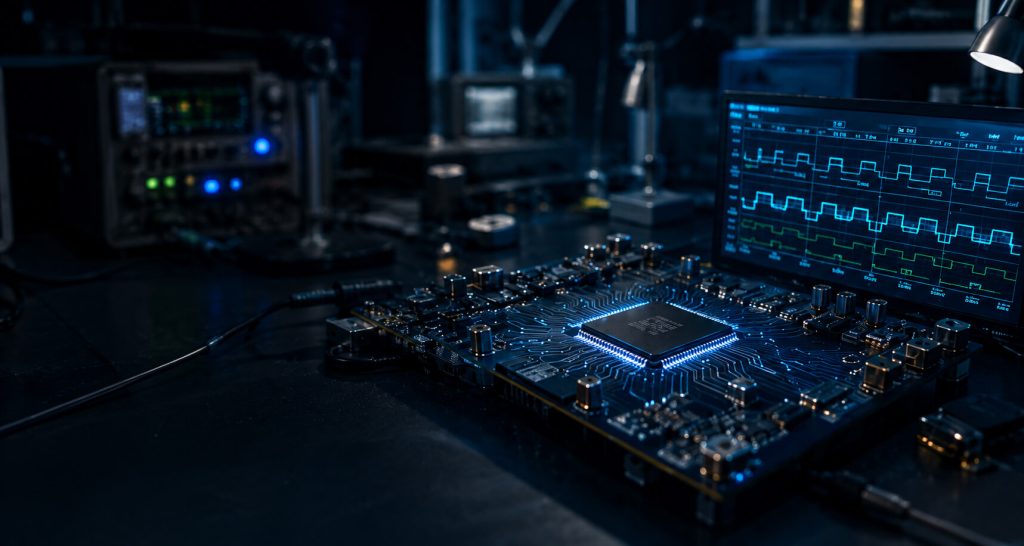
Why projects get stuck
Diagnosing the Real Source of the Problem
FPGA failures are not always caused by a single RTL bug. The root cause may be hidden in the interaction between architecture, constraints, clocking, implementation, I/O configuration, PCB design, and device-specific behaviour.
We analyse the complete signal path and implementation flow to determine what is actually preventing the system from working correctly.
Typical rescue activities include:
Our goal
Understand the failure mechanism and implement a solution that remains reliable across builds, devices, operating conditions, and production units.
- correcting incomplete or incorrect timing constraints
- resolving setup, hold, skew, and clocking problems
- improving placement and routing
- optimising critical datapaths
- correcting CDC and reset structures
- stabilising high-speed interfaces
- resolving hardware bring-up problems
- identifying architectural bottlenecks
- correcting integration issues between FPGA logic, firmware, software, and the PCB
- reviewing transceiver, IO, and memory configurations
- improving resource utilisation
The objective is not to apply temporary workarounds. It is to understand the failure mechanism and implement a solution that remains reliable across builds, devices, operating conditions, and production units.
Salvaging Existing Hardware
Salvaging Existing
Hardware
We find viable solutions within the constraints of hardware that has already been designed or manufactured. Incorrect pin selection, limited clocking resources, PCB delays or signal-integrity problems do not always require a new board revision.
Case example:
We recovered an interface despite incorrectly selected FPGA pins and achieved operation beyond the conditions indicated by the component datasheet. See case studies.
Targeted Optimisation Before Redesign
A small architectural adjustment, an additional pipeline stage, improved clock-domain handling, corrected constraints, or better use of dedicated FPGA resources may be enough to make the design operational.
We preserve as much of the existing implementation as possible while addressing the areas that create the greatest technical risk.
This reduces recovery time, limits disruption, and protects the engineering effort already invested in the project.
Architectural
Recovery
When the design architecture cannot meet the required target, we redesign the affected subsystem – or, where necessary, the complete FPGA implementation.
The redesign is based on the existing requirements, hardware constraints, and lessons learned from the failed implementation, allowing the project to move forward without repeating the same mistakes.
An Independent Technical Perspective
An independent FPGA review quickly identifies assumptions that need to be challenged, constraints that are missing, and architectural decisions that are limiting progress.
We provide a clear technical assessment: what can be recovered, what must be changed, what risks remain, and what is required to complete the project successfully.

Rescue Before Restart
Most FPGA projects contain more recoverable value than initially appears. Before committing to a new PCB revision, replacing the selected FPGA, or restarting development from the beginning, it is worth determining whether the existing design can be rescued.
Brightelligence combines FPGA architecture, timing closure, hardware bring-up, verification, high-speed interfaces, and implementation expertise to turn stalled projects into working systems.